In Central Florida, sustainable development requires more from every project. Growth, water, regulation, and environmental systems are deeply interconnected, calling for solutions that create value without working against the land.
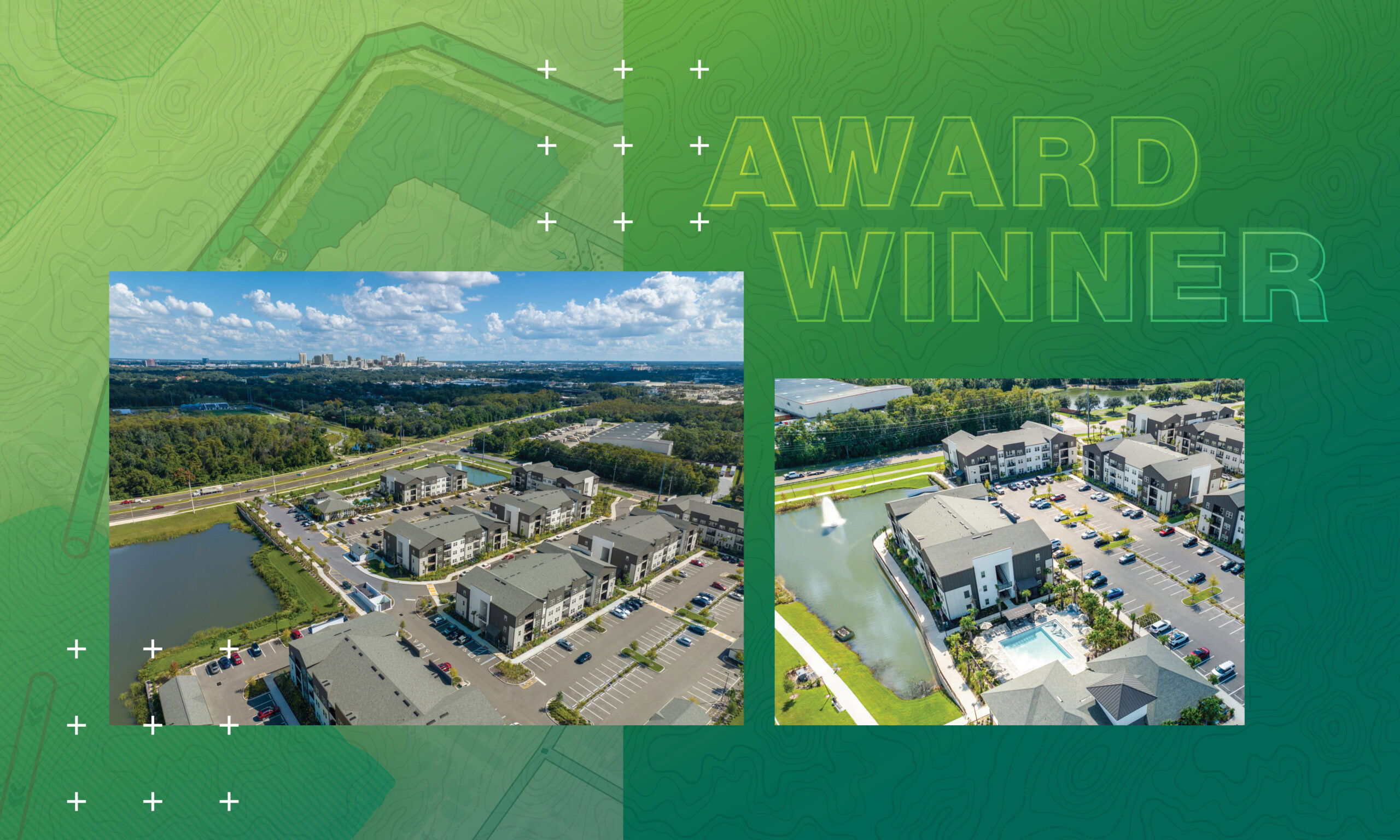
At District West, that meant rethinking how an underutilized Opportunity Zone parcel could deliver new housing while respecting the role water already played on the site. Once an FDOT borrow pit that evolved into a FEMA-designated floodplain, the site carried complex environmental and regulatory conditions.
Rather than treating those conditions as limitations, LandDesign made them part of the land development strategy—using FEMA floodplain modeling to understand flood elevation and storage capacity, incorporating the borrow pit into the engineered stormwater system, and preserving on-site flood storage while creating a viable path for a 240-unit multi-family community.

Recognized as the 2026 Sustainable Project of the Year by the American Society of Civil Engineers East Central Florida Branch, District West shows how sustainability can work inside a private development setting. The project reduces environmental disturbance, maintains regional drainage patterns, supports resilience during storm events, uses land efficiently, and helps bring needed housing to a growing area of Central Florida.
LandDesign Project Manager Brian Warren, PE, shares, “On a site like District West, the engineering has to start with listening to the land. The borrow pit, floodplain, drainage patterns, and regulatory requirements were all connected, so the solution had to be connected too. By working with those conditions, we were able to support new housing while preserving the stormwater function that was already there.”
For a region where growth and water are always connected, District West offers a practical example of what sustainable engineering can look like in a private development setting. By treating the land as an asset, the project supports new housing, protects existing hydrologic function, and creates a model for development that works with Central Florida’s environmental realities.
Read the District West case study to see how the land shaped the solution.